Okay, so what does it take to be a world-class brand strategist? And I’m going to insert different titles here: a world-class marketer, world-class web designer, world-class web developer, world-class strategist, or just a creative professional in the agency space. Maybe not even in the agency space, but these are the three ingredients, these are the three areas that one has to be skillful at. They have to work on these three different areas in order to excel in agency life. I always go through this example and this diagram, which I’m going to show you in a second, with every intern that joins Big Red Jelly and definitely every new team member or employee. I constantly remind our team, “Hey, you need to be working on these three areas of yourself as a professional in order to excel.”
The Foundation: Zero Talent Required
To be honest with you, with the introduction of AI and these tools that just make creative work way more approachable, for example, Canva, web design platforms like Wix, Squarespace, Shopify, etc., and definitely with the introduction of AI, these three areas are now more important than ever for someone to excel and stay ahead of the curve. You can now use these tools, like these AI tools, to empower you and propel your professional career forward, but you have to work on these three skills.
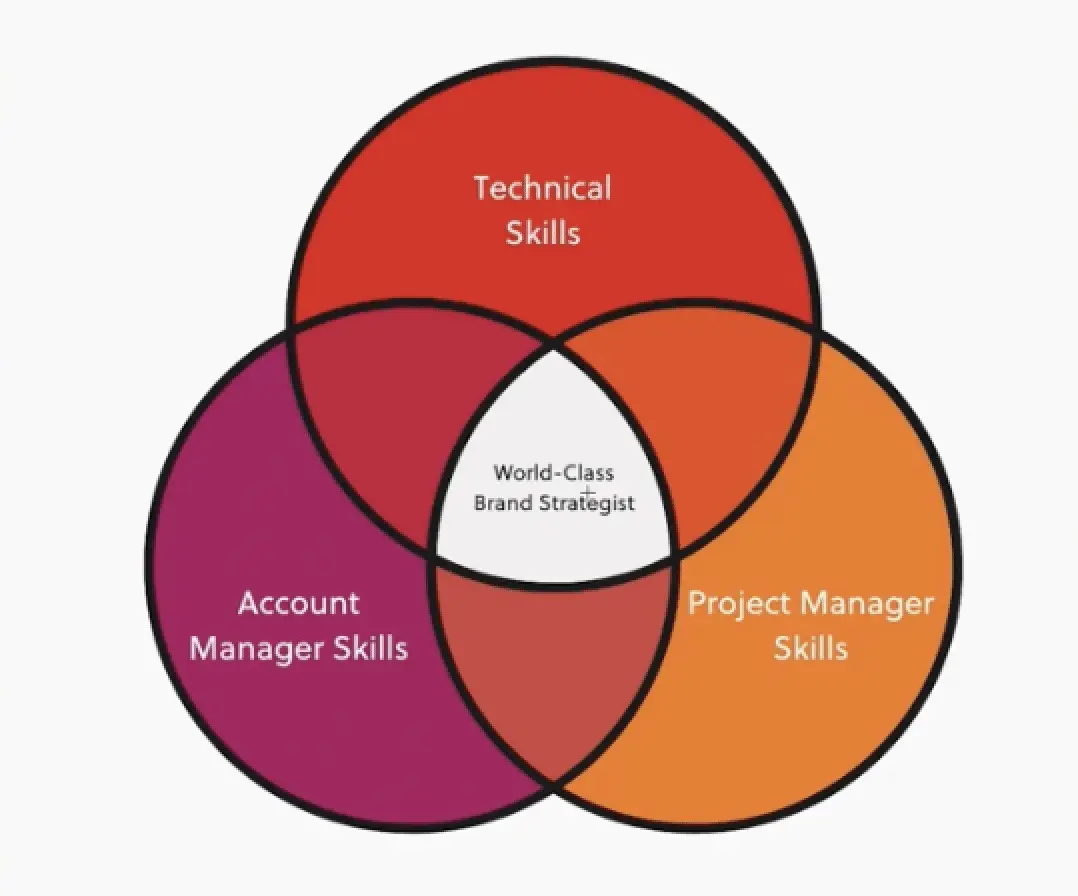
So, let me pull up this graphic. Let me move down here. I’m going to keep this large. Okay, here it is. Now, to be honest with you, when I made this Venn diagram, there is a fourth potential circle here. It’s just probably throughout, right? There’s one filter that, before we talk about these three, you need to keep in mind. There’s one area that you have to check the box for, and that is everything that requires zero talent. So, we say here at Big Red Jelly, it’s a quote from a famous rugby coach Warren Gatland: “Be the best at everything that requires zero talent.”
So, before we even talk about these three areas, be the best at everything that requires zero talent. What does that mean? What requires zero talent? Let’s go through some examples. Although there are infinite examples: show up on time, dress appropriately, take notes, be proactive, be a culture builder, be a great communicator, be organized, work hard, offer help, offer to do the tangential things, be that note-taker, be the one who sends the follow-up email after a meeting, be the one who returns and reports to your boss without having to have him or her follow up, be the one who’s engaged in meetings, be the one who offers advice, be the one who dresses maybe just one step above what’s required, show up a little bit early, stay a little bit late, go the extra mile. All of these things that we hear over and over again that are not taught in the classroom are just characteristics of a world-class professional.
To speak candidly, these are things that I look for right out of the gate because I can teach you these things. I can teach you these three areas. You can learn the skills, the dos and don’ts in these three areas, but it is very hard, and I don’t have the time nor the interest to teach you how to be a professional. So, be the best at everything that requires zero talent. That’s 90% of any job, no matter what you tell me. Do those things right, knock those out of the park, and you’re going to excel no matter where you go. You can learn the technical skills.
The Three Key Areas for Success
1. Technical Skills
So, that is step number one. Once that’s accomplished, then we can propel into this. So now, let’s say you’re a brand strategist. In fact, I have the wrong graphic here. I had in the middle here “world-class brand strategist.” Let me pull up that example. It’s a better one. There it is. But again, insert title here: web designer, graphic designer, logo designer, brand strategist, account manager, whatever.
There are three areas here. The first area is the one that people tend to focus on the most, which is the technical skills. Let’s use brand strategist as an example. Let’s say I’m a graphic designer by trade. The technical skills are the thing: do you know how to design? Do you know how to use Adobe Creative Cloud products? Do you know design fundamentals, color theory? Can you actually deliver a world-class logo, brand style guide, or brandscape, and what have you? The technical skills are the foundation of your success. So you should be constantly learning. Same thing with web designer, copywriter. Can you actually produce the thing? This is a no-brainer. Most people are like, “Of course, Josh, if I apply to be a graphic designer, I should know how to design.”
This is the obvious one. It should constantly be improving and refining these skills here. That’s constant. But most of the time, what I bump into with young folks or people who are new to the agency space is that this is kind of where it ends. They assume that this is the job. I think back in the day, and when I say back in the day, it’s not even that long ago, you could get away with this because you were the person who did the design. You were an absolute essential component to the agency. Now, with the introduction of AI and with demand from what clients are asking for, they want and need more. We’re not far away from tools, platforms, and technologies that can do a lot of the thing. If you look at CoPilot, ChatGPT, Gemini, and their ability to spit out code, if I’m a coder, if I’m a developer, yes, I still need to know how to develop, but I don’t think it’s far away from there being a technology that can just do it better than you can. It’s replacing a lot of the technical skills.
The technical skills are becoming more commoditized, more approachable, and more people can do them. So now what? How do I position myself as a successful agency professional? You have to look at these other two areas. I’ve said this for years, that with the introduction of AI and these technologies, it puts more emphasis on two things: strategy and creative. Strategy and creative. You still need to know what to prompt the AI, still need to know what direction to go, still need to know how to think outside the box and apply that to a strategic campaign or brand strategy, etc. Technical skills should always be worked on, always refining our technical skills and getting better at the thing.
2. Account Manager Skills
Now let’s jump across to account manager skills. These are soft skills. I cannot emphasize this enough. I interview hundreds of creatives every year, and sometimes I’m absolutely floored. In fact, most of the time, I’m floored by the portfolios and the creative work. I’m going to speak frankly here: I hop on a video call or an interview, and I don’t know if we’re even speaking the same language. No offense, but it’s like, “Wow.” Walk me through this logo design that you just did and the struggle there. Or, “Hey, help me understand how your brand style guide is going to help my business grow as a small business owner, as an entrepreneur,” and then the inability to do that. That’s not going to work anymore. It’s not going to work anymore. I’ll speak for Big Red Jelly: we require our strategists to be strong in all three areas. You need to be able to do the thing, i.e., the technical skills, and you need the account manager skills, the soft skills, to be able to communicate with your clients, to be able to pitch your ideas, to handle constructive criticism, to convince a client of what a good fundamental design is, and to present effectively. Account manager skills are your soft skills, your public speaking skills, your inner salesperson.
I’ve said this many times to new brand strategists: I’ll say, “Hey, you’re a far better graphic designer than I. Let’s take the same logo, your logo, present it to the same client hypothetically, and my client will like your logo more. It’s the same logo, same client, everything’s the same, it’s just because I can present it better. How do I set it up? I explain the why. Can you connect the dots? How does this logo help the business owner make more revenue, succeed, and achieve what they want? Can you connect those dots, or do you just design?”
If you just design and someone else is pitching the ideas, I highly encourage you to talk to your boss or the structure of your agency and say, “No, I think that businesses more and more, I know that clients are asking for communication directly from the creatives. We don’t want this traditional account manager structure where someone behind the scenes is creating, designing, and doing all of the work, and then someone comes in as the account manager and has to present and pitch it to the client. They can tell. They know that you didn’t do the thing.”
So, what does that mean? It means that the technicians, the creatives, now have to be able to present. They have to be confident. They have to know how to speak clearly. They have to be passionate. That’s a skill. I get fired up about account management skills. That’s kind of what my strength is: the account manager skills.
You can start to identify which of these areas is a strength of yours and which one’s a weakness. How can you improve in some of these areas? How can you lean into ones that are strengths? That’s account manager skills: soft skills, your ability to present, your inner salesman. Embrace that. You can have the perfect brand style guide, the perfect landing page, the perfect copy, but if you are incapable of presenting it, explaining why, and connecting the dots in a simple way that makes sense for your client, it doesn’t matter. I’ve seen that stuff just get thrown out the window.
How do you improve account manager skills? There’s a lot of advice; this is a whole other video, but one pointer I would give is that it’s just like anything else in life: it’s repetitions. Just like your technical skills, how do you get better at designing logos? Go design logos. Go sketch, draw, and do the thing. You can read about it, you can watch it, but nothing is as good as actually doing it. So, how do you get repetition in account management skills? I like to remind our people to get reps inside the agency. Do mock pitches, mock presentations, walk through your work with several of your team members before the client call. Raise your hand and participate in every meeting possible. Just practice speaking, asking questions, responding to criticism, and pitching your idea. Reps, reps, reps. Everything comes down to repetitions.
Another kind of trick of the trade I recommend is if you have a client call coming up, let’s say it’s Wednesday, and it’s the first draft review of a new brand guide you’ve been working on, or it’s the copy for their brand messaging, record a Loom video walkthrough and send it to your client ahead of time. What does that do? It allows you to get twice the reps because now you can present your work in the walkthrough video and on the client call. So you get twice as many reps if you do that every time, and it allows you to present your work without any interruptions or pressure. Repetitions, repetitions, repetitions.
This is usually where I see most creatives fail: the account manager skills. Great technical skills, decent project managers, but their account management skills leave a lot to be desired.
3. Project Manager Skills
The final circle here, the more I work in the agency space and the longer I own an agency, the more I value this skill. It is probably the most underrated, and that’s project manager skills. What does that mean? Are you organized? Do you keep timelines? Do you know how to use your calendar? Does nothing fall through the cracks? Do you have a clear agenda? Are you just really good at organizing and keeping your project or client work on budget, on time, and nothing falls through the cracks? We have a couple of individuals here that I always shout out because they are just amazing project managers. Great note-takers, send a follow-up email after every single call, send a prep email before every single call. Their client work in monday.com, which is our project management software, is so detailed, organized, and always up to date. I never have to remind them of anything, and nothing is forgotten. That is such a skill.
Again, I bump into creatives who are great technically, they can do the thing, and wow, they’re also great people people, great account managers, very good at presenting. But then when you come into project management, it’s sloppy. Things are flying through the cracks, things are late, we’re spending too much time over here, the client asked for these things but we forgot. There’s only so much you can get away with. The account manager skills and I’ve seen that they do amazing work, are really good at presenting, but eventually, that will catch up to you if you do not have solid project manager skills. You’ll overwhelm yourself, get burnt out because you don’t know how to manage your time, start to forget things, or things will fall through the cracks, and eventually, your client, boss, or colleagues will see that and say, “Hey,” and you start to lose trust, you start to lose confidence. This is one of my weaknesses. I’m weak here, and I’m trying to work on it. I’m trying to be better at taking organized notes, having a roadmap and sticking to it, and being much more disciplined with my time and calendar, saying no to things so that I can prioritize certain client work. What an underrated skill here.
So, how do you practice that? Again, repetitions. Another trick of the trade here is I recommend there’s always someone who’s a really good project manager in your organization or your team, and you’re probably already thinking of that person who’s organized, always on time, punctual, takes notes, just very impressive in that regard. Spend more time around them. Be on calls with them, watch what they do after a meeting, watch what they do to prepare for a meeting. How do they do their weekly planning, their daily planning? What does their checklist look like, if they have checklists? What an underrated skill.
I really look for that as well. When we interview creatives here, I look for these two. I’ll give homework to the applicant and say, “I need these things very specific before this time.” We’ll see if that happens. I also wait to see if they send me a follow-up email or preview email. Are they good project managers? This is another thing that agencies are doing more and more of. The creative, the strategist, is required to be the account manager. They must present their work confidently and clearly, and they must also manage their work. That leads to more efficiencies for the agency, especially if they are more on the project side, where projects are moving quickly. We don’t have time to go hire a project manager and have them project manage all your work. Instead, this is just the new bar: you have to be able to do the thing, present the thing, and then manage the thing. At least that’s how it is done here, and that’s why we have a really high standard for strategies here at Big Red. So you can see why the technical skills, I think, will get you through the door. Your portfolio will wow an agency owner or a client, but if you get on the call and you cannot present it effectively, it’s hard to proceed, hard to grow. If you do present it effectively, but then things start to fall through the cracks or you’re late on things, that will eventually catch up to you. This is usually the final symptom. It is slower to see, but it will make itself apparent if it’s a weakness.
Wrapping Up
These are the three areas, but don’t forget there’s that first step that needs to be accomplished before we get into these three areas, which is: be the best at everything that requires zero talent. Then you can constantly be working on these three areas. Here at Big Red Jelly, when we have team meetings, we’ll do trainings and cycle through these different areas. One team training or team meeting, we might really just focus on, “Hey guys, let’s go over UX/UI fundamentals for a solid homepage that converts.” Let’s go through how to optimize your website forms for higher conversion. Very technical. Let’s just learn the thing. But then we’ll go over something that’s all about account manager skills. We’ll watch video recordings, critique each other, say, “Hey, that client asked a really good question. Let’s see how Zach responds. What could he have done better? Are we using our hands in videos? Are we animated? Are we passionate, for crying out loud?” We’ll also go over project manager skills. These might be the boring meetings, but man, I really am starting to value this more and more because it’s such an undervalued skill. So guys, if you’re watching this, give that some thought. Think about where you are strong and where you are weak in these three areas. You can start to improve and excel in agency life if you focus on these. Work with your boss, work with your mentor, with your manager, and say, “Hey, I think I’m strong here, but help me get better with my account manager skills,” and they will. So give it a shot. Thanks for joining me. Tune in next time.