Summary:
Who this article is for:
- Entrepreneurs and small business owners building or refreshing their brand
- Marketing leaders responsible for brand consistency and asset production
- Founders ready to move beyond a logo and activate a full brand identity
Key takeaways:
- Brand assets without strategy are noise — they waste time and fill digital space
- As AI lowers the barrier to execution, strategy and originality become your competitive advantage
- Authenticity and differentiation matter more than perfection or trend-chasing
- Know which assets to build first based on how your business sells and markets
What’s inside:
- Why brand assets matter (and what makes them strategic)
- The power of a distinct brand identity
- How to create better brand assets
- The Big Red Jelly Proven Process
- The ultimate library of brand and content assets
- Final tips for scaling your brand assets
- FAQ
As the CEO and co-founder of Big Red Jelly, I spend my days obsessed with one question: how do we help businesses grow in an increasingly noisy world? Things aren’t just moving in the branding and advertising space — they’re accelerating at a rate that can feel dizzying for even the most seasoned entrepreneur.
With tools like Canva, Webflow, and “no-code” platforms lowering the barrier to entry, the space is getting crowded. But here’s what I’ve believed since starting Big Red Jelly nearly a decade ago: as technology and AI make execution easier, the market will place a massive premium on two critical areas: Strategy and Originality.
Why Are Brand Assets Important?
Before you jump into a design tool, we need to talk about the recipe for success. A brand asset or a piece of content means nothing if it isn’t backed by true strategy. Without strategy, an asset is a negative — it’s just noise that wastes your time and fills up digital space.
Consistency isn’t just about using the same logo. It’s about your assets working toward a unified goal. Before you create, you must have your positioning on point — through quantitative and qualitative research, industry analysis, and a deep dive into revenue attribution to understand where your growth is actually coming from.
The Power of a Distinct Brand Identity
True creative is taking different pieces and putting them together so that the whole is greater than the sum of its parts. My best advice for small business owners? It is better to be different than to try to be better.
Think about the brands that have really scaled fast — Liquid Death, Starbucks, Amazon. These are brands and companies obsessed with being different. When you have a clear strategy, your brand assets become tools for differentiation, not just decoration.
[Image: Strong brand identity examples showing differentiation in action]
How to Create Better Brand Assets
Creating “better” assets isn’t about higher resolution — it’s about higher resonance. Here are two universal truths I’ve observed as AI becomes mainstream:
1. Authenticity Trumps Perfection
We’ve moved past the polished “Instagram Aesthetic” of the late 2010s. Today, platforms like TikTok have flipped the script. Users — especially younger generations — crave transparency and the human element. You will get more traction with a simple handheld iPhone video of your CEO speaking directly to the audience than a super expensive, highly edited, scripted production.
2. Watch the Pendulum, Don’t Chase the Trend
Branding is a pendulum. From 2010 to 2020, we saw “Millennial Minimalism” — white space, sans-serif fonts, and sleek modern logos. Now the pendulum is swinging back. To stand out, brands are leaning into organic imperfections: hand-drawn logos, handcrafted typography, and maximalist packaging.
Don’t chase trends. If you don’t know your brand DNA and positioning, you’ll find yourself exhausted, constantly chasing the next thing. Build on a foundation, not a fad.
The Big Red Jelly Proven Process
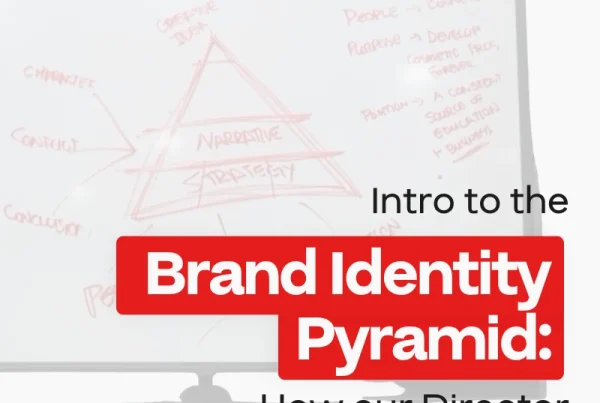
At Big Red Jelly, we follow a rigorous, 10-chapter process to ensure that when we finally get to the design phase, the brand is built on a rock-solid foundation.
- Brand Discovery — Uncovering the “why” behind your business
- Brand Research — Analyzing the market, competitors, and audience
- The Guiding Idea (Strategy) — Setting the north star for the brand
- Brand DNA — Defining the personality and values
- Brand Core — Distilling the mission and vision
- Brand Messaging — Developing the voice and key taglines
- Visual Identity — Designing the logo, color palette, and typography
- Brand IP — Protecting your intellectual property and unique assets
- Execution and Assets — Turning everything into the tangible tools you use to grow
- The Brand Guide — Bringing it all together into a manual for your team
You’ll notice that visual identity is Chapter 7 and execution and assets is Chapter 9. That’s intentional. You don’t create assets until the brand is built.
[Image: Big Red Jelly’s 10-chapter brand building process visualization]
The Ultimate Library of Brand and Content Assets
When you’re ready to execute, you need to know what you’re building. Storing all your assets in one centralized location ensures they’re accessible and usable by your whole team. I break brand and content assets into three categories:
1. Brand Templates
Templates are about scalability. Create them once, use them thousands of times.
- Business Card & Letterhead Templates
- Email Signature Template
- Social Media Post Templates
- Email Newsletter Template
- Brochure/Trifold Template
- Slide Deck Template
- Lead Magnet & Flyer Templates
- Blog Cover Template
2. Actionable Designs
These are the specific designs that live across your digital and physical channels.
- Social Media Profile Covers & Profile Pictures
- Virtual Meeting & Desktop Backgrounds
- Curated Imagery & Icon Sets
- Infographic & Ad Designs (Digital/Print)
- Web Banners, Flyers & Event Materials
- Blog Cover Designs
3. Brand Mockups
Mockups create a sense of realism. They show your brand “in the wild” and build instant legitimacy.
- Logo & Merch Mockups (Swag/Apparel)
- Vehicle Wrap Mockups
- App Icon & Package Mockups
- ID Badge Mockups
- Billboard/Sign & Brand-in-Action Mockups
Final Tips for Scaling Your Brand Assets
You cannot do everything at once. Focus on the assets that will do the heavy lifting for your specific business. Here’s how:
- Prioritize by industry. Home services need stickers and print leave-behinds. B2B companies need LinkedIn profiles and email templates.
- Organize early. Don’t let your Canva or Google Drive become a digital graveyard. Create a file structure your team can actually navigate.
- Optimize and A/B test. Your brand is a living thing. See which templates get the best feedback and iterate.
Building a brand is a journey — but you don’t have to do it alone. If you’re ready to move from “just a logo” to a fully activated brand, our team at Big Red Jelly is ready to help. Explore our branding services or check out our growth strategy to see the full picture.
Frequently Asked Questions About Brand Assets
What is the difference between brand assets and content assets?
Brand assets are the core foundational elements — your logo, color palette, and typography. Content assets are the specific pieces of media you create using those elements, like a blog post or a social video. Brand assets are the “ingredients,” and content assets are the “meal.”
Why are brand assets important for business growth?
Brand assets are how the world perceives your professionality and consistency. High-quality, strategic assets reduce buying friction and build the trust necessary for a customer to choose you over a competitor. Consistent assets make your business recognizable and foster loyalty over time.
How do I know which assets to create first?
Start with the assets you’ll use most often in your sales and marketing process. If you’re a local service provider, that might be a sticker or a flyer. If you’re a digital consultant, it’s likely your LinkedIn banner and email signature. Think about what you’ll use hundreds of times over the next few years.
How do I create better brand assets with AI?
Use AI to speed up execution of variations — but never for strategy. AI is great for generating 50 versions of a social post once you have the guardrails (your brand guide) in place. Always ensure your AI-generated assets align back to your Brand DNA.
What are the most common brand templates a business needs?
At a minimum, most businesses should have templates for social media posts, email newsletters, and slide decks. These allow your team to create content that looks professional and consistent without needing a graphic designer for every single task.