
Who this article is for:
Business Owners, marketers, branders
What’s inside:
- Why brand voice should matter to business owners
- Understanding what brand voice means
- How to develop your company’s brand voice
- Brand messaging as a key component of brand voice guidelines
Key takeaways:
- Brand voice guidelines make your business more valuable.
- Brand voice is important: Establishing a recognizable, consistent, and authentic identity helps connect emotionally with your audience, differentiates you from competitors, and builds trust and long-term brand awareness.
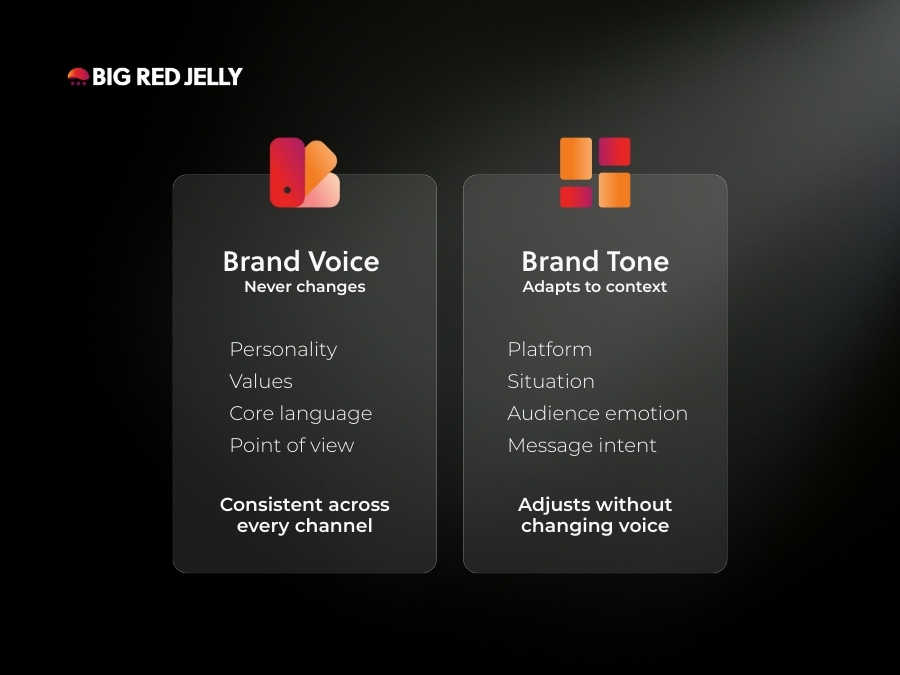
- Brand voice never changes, and brand tone changes depending on context.
- Developing meaningful brand voice guidelines requires significant work into developing your brand.
Having well-defined brand voice guidelines is one of the most critical levers business owners can pull to build a community of loyal customers, and ultimately a valuable business. This is highly important for business owners focused on the long-term.
In 2026, it has become incredibly challenging to stand out in your marketing. It feels like just about every product or service with demand has to deal with competing against huge companies that have massive marketing budgets, and you have no chance at standing out. This is not true! Don’t give in to that discouraging belief.
So how can you stand out? The key is in having a consistent, memorable, distinguishable brand voice! A recognizable brand voice not only sets you apart but also helps build connections with your audience, fostering trust and loyalty. Your brand voice gives your marketing power, when done right. It is the key to having people resonate with your message. If you want customers to trust you before you ever talk to them on the phone, develop a strong brand voice. It will pay huge dividends.
What is Brand Voice?
What are brand voice guidelines? What is brand voice? Brand voice is the way your brand communicates. Brand voice refers to the personality, tone, and language your company uses in communications to reflect your brand’s identity and connect with your audience, reinforcing your overall branding and storytelling. It never changes. Having well-defined brand voice guidelines is the key to having a brand voice that resonates with your target customer. An important thing to note about brand voice is that it doesn’t change. It stays consistent across all blog posts, social media posts, videos, email, and any other medium you use to communicate with your customers.
Tone of voice is a related but distinct concept; it is a crucial aspect of branding that influences how your company sounds to its audience and can be adapted according to context while maintaining your overall brand identity.
What is Brand Tone?
Ever heard of brand tone? Let’s make an important distinction. Brand tone does change. Depending on what the message is that you’re trying to get across, your tone can be more serious or more friendly. Different communication channels may require different tones. For example, your tone on social media might be more casual, while emails or blogs could be more formal or informative to suit the platform and audience.
Using the right tone helps create a sense of trust and credibility with your audience.
Why You Should Care About Brand Voice and Brand Tone
The difference between brand voice and brand tone can be subtle. The most important takeaway for business owners is that you must consistently tell the same message to your target customers that will resonate with them. To achieve this, focus on your brand’s core values and messaging to ensure consistency across all communications. At the end of the day, marketing is just talking to people. If you can do this effectively, your marketing will bring in valuable customers! A consistent brand voice also helps create deeper connections with your audience, making your brand more relatable and memorable.
Core Components of Brand Voice Guidelines
Before developing your brand voice guidelines, start by analyzing your brand’s current voice and brand sounds. Assess how your communication style, tone, and manner of expression are currently perceived across all content channels to understand your starting point.
Let’s take a closer look at the different elements of developing brand voice guidelines.
Brand Personality
In order to have a strong brand voice, you must start by defining your brand’s personality. Identify specific brand personality traits. These are the human-like characteristics that represent your brand’s identity and guide how you communicate. These personality traits influence your tone, messaging, and content creation, ensuring consistency in your brand’s communication.
Also, think about your target customer. What do they need from you? How can you help them? Think about your customer as the star of the movie, the hero’s journey. You are the guide to help them. As an example, at Big Red Jelly, we work with business owners who need help with their marketing. They need a strategic partner who will help them. Ideally, this person will be clear, confident, and collaborative, which is how I am trying to write today!
Don’t forget to consider your brand values and your brand’s core values, as these are fundamental in shaping your brand’s personality and authentic voice. Aligning your core values with your communication style ensures consistency and a genuine connection across all platforms.
Tone
Another component to look at has already been mentioned – your tone. Tone can change depending on the context of the situation. For example, your tone might be fun and playful to help your brand stand out, or helpful and supportive to position your brand as a guide for your customers. You want to have a more empathetic tone if you are talking with a customer who is going through a rough patch than you would if you’re talking with someone who recently achieved a huge milestone. It all comes back to understanding your target customer and their needs, desires, pains, etc.
Tone can also vary depending on the platform you are using. People come to different platforms for different reasons, and while you still want to maintain the same brand voice across all platforms, you may want to adjust your tone in these situations. This will depend on the product or service that you offer, but it may be the case that people go to your YouTube channel to be educated, and they come to your TikTok page for a good laugh.
Language and Style
Brand voice can dictate what vocabulary you use. This is incredibly important because it is a chance to show your audience that you use the same language and words as they do. Listen to your customers’ emails, notes, and calls to identify key words and phrases that help craft an authentic and relatable brand voice.
Sentence length is another key element. Using short sentences can help create a clear, confident, and straightforward brand voice. Concise statements improve clarity and make your messaging more impactful.
Using proper grammar, punctuation, and capitalization is highly important as well. You may remember your 4th grade teacher telling you this, but it’s very true! There aren’t many quicker ways to lose credibility than to show that you don’t know how to write properly.
Finally, set guidelines for your brand voice and tone to ensure consistency across all content types and communication channels, while allowing for contextual variations as needed.

Steps to Create Brand Voice Guidelines
So let’s get a little bit more practical on brand voice. It sounds nice, but how can you actually ensure that you get the most out of having a consistent brand voice? Remember, there is no one size fits all approach. Your brand voice guidelines should be tailored to your unique brand and audience.
Define Your Brand’s Core Values and Mission
It’s not possible to have a fully developed brand voice until you understand your brand’s core values and mission. Why does your company exist? How do you help people? If you and your team don’t understand this, there’s no way your customers can understand it. Deeply understanding your brand will vastly improve your ability to craft meaningful communication that resonates with your customers. Looking at other brands, including tech companies like Apple, can provide inspiration for how a confident and distinctive brand voice can set you apart.
Conduct a Content Audit
A content audit can be a great opportunity to reflect on if you’re being consistent and if you are writing in the way that embodies your brand. Review your current content (such as past blog posts, emails, product descriptions, and social media posts) to assess how well it aligns with your brand’s identity and voice. Identify ways to improve and make a plan to implement these changes, ensuring that all product descriptions and messaging reflect your brand voice.
Document Your Brand Voice
It’s going to be very challenging to maintain your brand voice if you don’t have it documented somewhere you can reference frequently. Understanding your own company’s brand voice is not enough. If you hire a new team member or a marketing agency, they are not going to match your brand voice.
Be sure to include key messaging and brand messaging in your documentation, outlining the core statements and messaging pillars that communicate your brand’s identity. Take this a step further by providing examples of do’s & don’ts. This gives your team members and collaborators the ability to see your brand voice in action and how to replicate it. Clearly define how your brand should speak to your audience to build authentic relationships, not just broadcast information.
Train Your Team
Training your team on using your newly defined brand voice is a critical point, where you must show them why this is important in order to get the necessary buy-in from them. This comes back to when you defined your brand. If the brand foundation is strong, and comes from a place of trying to help your target audience as much as possible, then it will be far easier to generate buy-in from the team. Make sure everyone is on the same page regarding your brand voice and messaging, using consistent language and collaborative tools to maintain cohesiveness across all customer interactions.
Best Practices for Brand Voice Guidelines
Keep these best practices to keep in mind when writing anything on behalf of your brand in order to best connect with your target audience.
- Stay authentic and consistent
- Keep it simple, readable, and audience-reflective
- Use positive and empathetic language
- Align voice with visuals, tone, and overall brand identity
- Refresh guidelines as brand evolves
Common Mistakes to Avoid
On the flip-side, there are some key pitfalls to keep in mind. Doing these can cause your message to get diluted and result in people ignoring your message or feeling annoyed by it.
- Using voice inconsistently across channels
- Ignoring audience language and context
- Overloading guidelines with unnecessary complexity
Inconsistent brand voice can also hinder your ability to build recognition and trust in the wider world, making it harder for your brand to resonate globally.
Conclusion
Brand voice is one of the biggest opportunities for business that are focused on the long-term. In 2026, the most valuable part of your business is your customer base. If you have a loyal, highly engaged audience, you will have a business that others are willing to pay handsomely for. But you don’t build a highly engaged audience by sharing a scatter-brained message across different channels, and not having consistency.
Engaged customers and communities form when people feel understood. People feel understood when you show them that you understand them by the way you communicate. Good luck with defining your brand and your brand voice guidelines!
If you want help defining your brand, Big Red Jelly is here to help!
Frequently Asked Questions About Brand Voice Guidelines
What is the difference between brand voice and brand tone?
Brand voice is the unchanging personality of your brand, while brand tone is the emotion that you convey that changes depending on platform or context.
How do I know if my brand voice is working?
Pay attention to how customers feel about your brand. Look at your reviews, send out surveys, or just call them up on the phone and ask them. If they love your brand, you know your brand voice is working.
How long does it take to develop brand voice guidelines?
A powerful brand is not developed in one sitting. Expect to spend a few hours per day over the course of a few weeks to develop a powerful brand that resonates with your customers. This can be an iterative process, and it’s possible your brand changes over time.
Do small businesses really need brand voice guidelines?
This is a great question, and understandable that brand voice guidelines may not seem like the highest leverage activities. However, if you are focused on the long-term, building out specific brand guidelines can be one of the most valuable things you can do as a business owner. You won’t build a powerful brand that resonates strongly with people without brand guidelines.
Should my brand voice change as my business grows?
It very well can. It can be a challenge to pinpoint who your target customer is, especially at the beginning stages of your business. If your target customer changes, your brand voice ought to change. It can also change if your offering changes, or other factors.







![A man sits at a desk wearing headphones, partially obscured by a colorful banner reading “[Your Personality Here]” in bold white letters. The background is red and blurred, hinting at his focus as a brand strategist at work.](https://bigredjelly.com/wp-content/uploads/2026/03/Brand-Personality-Examples-Cover-Photo-copy-600x403.webp)
