We all consume ads daily, and often in ways we don’t expect. A YouTuber shouting out that BetterHelp is their sponsor, a man on TV claiming that Tide cleaned his work shirts better than others… Sometimes there are even ads placed on the products that we buy, like on the back of cereal boxes or packaging. As audience members, we aren’t stupid to the world of advertising. Companies need to get their names out there, and they need to find fresh, creative ways to do so. Sponsorship is a huge way to get products out into consumer view–– but at what point does it become too much? Let’s take a Mosasaur-sized bite into the concepts that make product placement more manageable–– using the newest Jurassic World as an example.
Brand Bargain? Storytelling Sale? Dino Deal?
An interesting thing to note is that in media like movies and television shows, a mention of a brand or a product does not necessarily mean that the product sponsored the aforementioned media. For example, in the Disney movie Bedtime Stories, a “cherry red Ferrari” is mentioned repeatedly as part of the story. Adam Sandler’s character desperately wants to get one, and it is a coveted car that even the kids can recognize. However, the car brand did not sponsor the movie.
Sometimes, adding real-life products into a story just helps the writing to feel more authentic. In the ever-famous tv series of Friends, Coca Cola was not a sponsor, but characters drank sodas on a few occasions. Additionally, Coca Cola launched a marketing campaign using the cast to try and get more Diet Coke sales. In an interesting way, these two entities created their own marketing relationship, with Coca Cola being the ones who benefitted most from the famous cast.
This means that the term “product placement” can mean sponsorship, but sometimes can simply mean a product is mentioned or placed on a set.
When you think about it, this makes a lot of sense. It would be impractical, and maybe even impossible, for every product in every screenwriting to be a sponsor. Especially considering how many tv shows and movies involve different competing brands!
In the new Jurassic World movie, all the following product placements were also official sponsorships for the movie.
Evolution of Product Placement
Since even the earliest days of movies, product placement has played a part. One of the earliest uses of this marketing tactic was in a movie from a century ago: The Garage. This movie had a sign for Firestone tires and many types of equipment with the Red Crown Gasoline label. Additional uses of product placement have occurred in movies like Back to the Future when Marty McFly asked for a Pepsi. This was, in part, because the Pepsi logo had changed in the timeline of the story, so it helped the audience see and visualize the time changes.
Welcome to Jurassic Marketing
Now that we’ve established some history of product placement, and what defines sponsorship, we can better analyze the aspects of Jurassic World’s sponsorships. There are three things worth thinking about as we unbury the secrets of placement: the companies, the use, and the effects.
-
A Single Brand
There was one very clear and obvious sponsor in the new Jurassic World movie: Mars Wrigley. This candy and snacking company produces many well-known snacks, like Twix, Starburst, and 5 Gum. The featured candies in Jurassic World were given their fair share of screen time–– the Snickers bar (the wrapper of which arguably sets off the events of the entire film) and Altoids mints (crunched on by the the quirky Dr. Henry Loomis, played by Jonathan Bailey).
What did these product placements do for Mars Wrigley? For one, the Snickers wrapper was featured for a long time, receiving close-ups before it caused the inevitable Jurassic disaster. The Altoids mints were clearly in camera view, almost centered in the camera. There was no question of what these products were, but rather when (or if) they played a role.
Another sponsor was the Frito-Lays company. Featured in a convenience store of the movie, prime packaging despite an overgrown setting, and right at the top of a shelf. How could we avoid seeing the delicious, golden, original Lays chips directly underneath the stalking dinosaur? As an audience, we can’t–– the product placement is just too clear.

What benefited the Jurassic World Rebirth movie was that these sponsors do not compete with one another. Frito-Lays does not have the sweetened products that Mars Wrigley focuses on, instead giving us those salty and savory combinations. This allowed both sponsors to coexist in the movie (unlike humans and dinosaurs–– I can’t be the only one who wants to pet the Spinos…). Whether you’re trying to find sponsors or become one, it’s important to keep in mind which brands may compete with one another and which ones are able to inhabit the same space.
-
Making the Placement Appealing
There were a few things Jurassic World did well in their placements. A tried and true use of sponsorship is to have a famous, attractive, or otherwise admirable actor with the product. This is where the bright new star Jonathan Bailey would come in. Audiences have raved about Bailey since his debut in the TV series Bridgerton, and his performance soon after in the first Wicked movie earned him even more fame. He was an obvious choice for celebrity names in the new addition to the Jurassic series, alongside actress Scarlett Johansson.
The movie placed Bailey in an innocent, sweet role of a doctor. One of his quirks? Chewing mints–– sometimes at inopportune moments. I’m sure you can guess by now which company’s mints he was chomping on. Putting your product in the hands of a popular person makes them look more appealing, and creates a subconscious thought: “If [famous person who I like] enjoys this product, I might, too.”
The placement of the Snickers and Lays is different, but still interesting: it is in a high-stakes situation. The Snickers wrapper gets abandoned on the floor before being sucked into a vent. The mystery and anticipation of where it went, and what damage it would cause, kept the audience’s mind on that Snickers wrapper. A similar situation is created when Lays bags are all over the shelves–– shelves that are the only thing standing between a young child and a deadly, toothy monster.
-
Effects of Product Placement
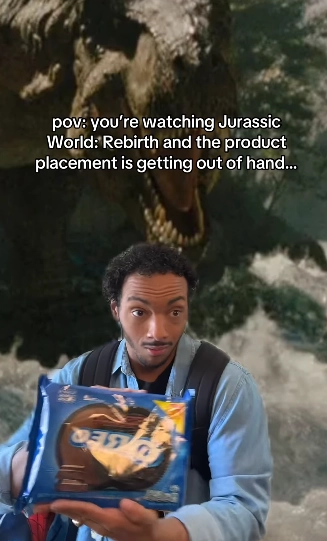
The difficulty of all these placements, and what the audiences have been discussing online since the movies’ release, is how obvious every placement is. They didn’t feel very subtle, to be sure, as was noted in this reel by @jlikescomics on Instagram.
So, the real question: did it work? What revenue changed, if any, and how did these product placements affect both the movie and the products?
While it is hard to determine when some information remains unpublicized, what we do know is that Frito-Lay was having some sales struggles in 2024. A sponsorship may have been an attempt to raise the sales, and now they are able to market their products with dinosaurs in order to bring audiences from the movie to the grocery store. Similarly, Mars Wrigley had goals to double revenue within this decade.
We cannot yet see numbers, but we can see that this is something companies are doing to increase revenue. It’s a tactic that has worked for others in the past–– for example, the generic characters (like potato head and Etch-A-Sketch) featured in Disney’s Toy Story skyrocketed in real-life toy sales after the movie’s release. Oliver Peoples sunglasses also saw a huge rise in their product sales after Fight Club’s Brad Pitt wore their red shades.
Though revenue effects are harder for us to track, what we can see is the discussion. Even though product placement was thinly veiled, or perhaps because it was, everyone is talking about it. Memes online, articles raving (or ranting) about the snacks, and even articles analyzing it like this one, may play a role in audience support.
The Rebirth of Ads

While there has been much discourse online about the uncamouflaged snack placement in the latest installment of Jurassic World, it is important to remember that how we advertise matters. It’s helpful to have product placements because 52% of consumers in the U.S. preferred them to ad breaks. The majority of your consumers would rather see your product being used or displayed in their favorite TV show than have it shoved violently in their face to interrupt the program. Numbers don’t lie–– even if it’s not subtle, at least it’s part of a story rather than a commercial.
This especially might become more true as we enter an age where people screen themselves from the ads that interrupt streaming services and social media. At the beginning of 2024, 36% of users paid to block ads on their streaming services. We can infer that with the increase of ads, this number has increased. If you were hoping to get an ad on Hulu or Tubi, that chance may be dwindling. It’s unlikely that unskippable advertisements will ever fully go away, but it is likely that more and more audiences will start to choose programs with more product placement and less breaks. Movies with product placement are setting the stage for these preferences to come to fruition.
The Dawn of a New Age: for Your Brand, Too!

Jurassic World Rebirth gave its audiences another action-packed movie with stars we love and products we now can’t forget. It used intelligent (and blatant) marketing tactics to utilize its screen time to the best of its ability.
Marketing your consumer goods in a movie is an excellent tactic–– but it can’t be the only strategy you use. Take our Brand, Build, Grow Audit today to see what YOU can do to strengthen your brand!