Summary:
Who this article is for:
- Business owners and operations leaders who have “tried AI” without it sticking — and want to know what actually makes it work
- Teams spending too much time on manual, repetitive work that keeps falling through the cracks
- Anyone curious about what Thalassa actually does and why BRJ built it
Key takeaways:
- Real AI business solutions are built around how your company actually works — not bolted on as a generic tool
- The first step isn’t picking a tool. It’s finding where things are actually breaking
- Guardrails, real training, and ongoing iteration separate lasting AI implementation from a two-week experiment
- Thalassa isn’t a replacement for Grow — it’s what makes Grow run the way it’s supposed to
- AI isn’t the product. The outcome is the product
What’s inside:
- Why most AI experiments don’t stick
- What real AI business process automation actually looks like from the inside
- How Thalassa fits into BRJ’s Grow framework
- The outcomes that matter: follow-up, lead nurture, reporting, and giving people their actual jobs back
I’ve watched a lot of business owners fall in love with AI for about two weeks.
They sign up for a tool, get a little dopamine hit from the first ten minutes, tell everyone at dinner they’re “using AI now,” and then it quietly becomes one more tab they never open again. I’ve done this myself. I once set up an automation so proud of myself I told three people about it before I realized I never actually turned it on.
Everyone’s tried the “just use AI” move. Almost nobody’s built anything that sticks. Real AI business solutions aren’t a random tool or a chatbot bolted onto a website. They’re tailored artificial intelligence systems built around how a company actually works, trained on its processes, and used to automate repetitive tasks, remove bottlenecks, and help the team focus on higher-value work. If you’re a business owner or part of a team trying to make AI solutions actually improve operations, that’s the difference that matters.
Here’s what it usually looks like from the inside before that happens. One person on the team is quietly using ChatGPT to write emails faster. Someone else tried a scheduling tool once and gave up after it booked something wrong. There’s no shared system, no shared knowledge, nothing connecting any of it. The business doesn’t have AI. It has a few people privately experimenting and hoping it counts.
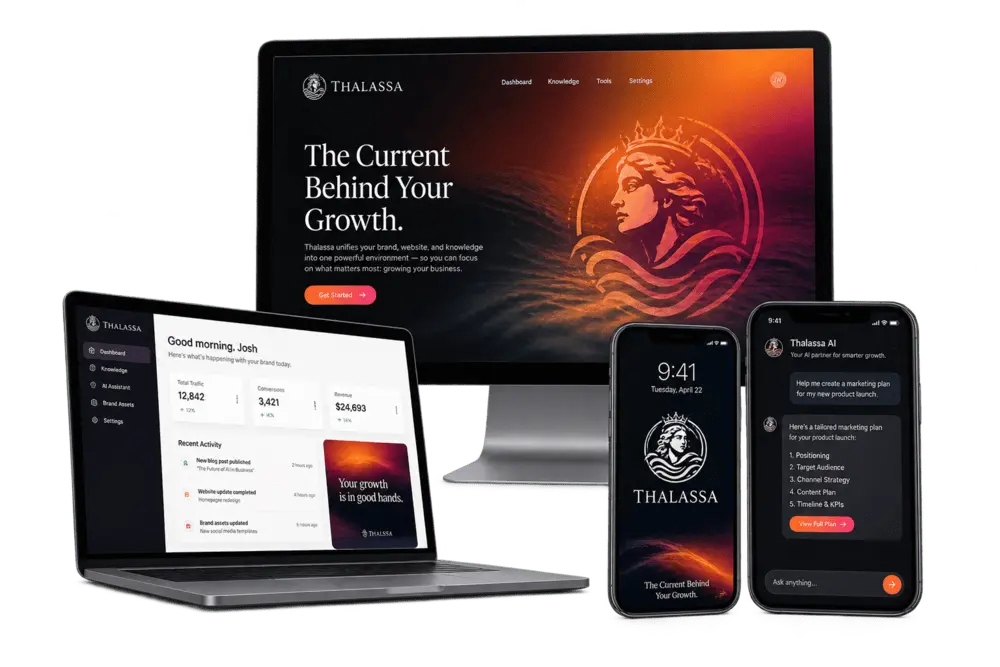
So when we started building Thalassa, the goal was never “give clients more AI.” Nobody needs to be impressed by a chatbot. What they actually need is someone who understands their business well enough to find where things are actually breaking, build something that fixes it, roll it out safely with real oversight, and train the team to use it well. That’s what this piece gets into: how to spot the right processes for automation, build custom systems around company-specific work, avoid unsupervised AI mistakes, and treat AI business process automation as an ongoing operating system change instead of a one-time setup.
AI isn’t the product. The outcome is the product. AI is just what gets you there.
What AI Automation Services and AI Solutions Actually Do
Here’s the version without the deck language.
First, we figure out what’s actually broken. Not “what AI tool should we buy,” but where the real bottlenecks are across your business systems. Where leads go cold. Where the same manual task eats an hour every day. Where knowledge lives in one person’s head and nowhere else.
Then we build an artificial intelligence system that actually knows your business. Not a generic assistant that sounds like every other chatbot. Real AI solutions aren’t a random tool or a chatbot bolted onto a website — they’re built around how your company actually works, using your SOPs, your voice, and your process so it can handle routine tasks with less human error instead of just describing them.
Then we make sure it’s not going to do anything dumb. Guardrails, privacy, data readiness, and a clear answer to “what happens if this breaks.” Nobody wants an AI system with no adult supervision.
Then your team actually learns to use it. Not a PDF nobody reads. Real training, built around what each person’s role needs.
And then it goes live — and it keeps getting better. This is the part that separates a real AI business process automation setup from a one-time tool purchase: it’s ongoing, because the business doesn’t need isolated AI solutions or one-off experiments, but a connected system that can enable businesses as they change.

Where This Fits with Grow’s Business Solutions
This isn’t a replacement for Grow. It’s what makes Grow actually work the way it’s supposed to.
Grow still needs a human doing strategy, creative, and the kind of judgment calls no system can make for you. What Thalassa takes off that person’s plate is everything underneath it. The follow-up that doesn’t happen. The lead nurture that falls through. The reporting nobody has time to pull together. All the manual stuff that has to happen for the strategy to actually land.
Think of it as the part of the engine you never see, quietly making sure the visible part runs the way it’s supposed to.
The Point of All of It
The goal was never “more AI.” It was giving people their actual jobs back while keeping human workers focused on higher-value work. The strategist gets to strategize. The creative gets to create. And the stuff that was eating everyone’s time in the background finally gets handled by something that doesn’t forget, doesn’t get tired, and doesn’t need a second cup of coffee to follow up on a lead.
That includes the follow-up that doesn’t happen — where AI solutions can analyze customer interactions so teams can spot missed follow-up opportunities and recurring objections the moment they surface.

It covers the lead nurture that falls through, using AI-driven personalization based on customer behavior to deliver relevant touchpoints in real-time across the right channels. It handles the reporting nobody has time to pull together by factoring in market trends and performance data so teams stay competitive without spending a Friday afternoon in a spreadsheet. Better personalization can improve marketing budget efficiency by 10 to 15%, making campaigns and content creation more effective at scale.
I still haven’t automated my own life half as well as we’ve automated some of our clients’. Working on it.
Ready to stop experimenting and start building something that sticks? Learn more about how we approach AI business solutions or book a call below to talk about Thalassa AI and how it works for your business.
Frequently Asked Questions About AI Business Solutions
What is an AI business solution, and how is it different from just using a tool like ChatGPT?
A standalone tool like ChatGPT gives you a general-purpose assistant. An AI business solution is a system built around how your specific company operates — trained on your SOPs, your processes, and your voice — and integrated into the workflows your team already uses. The difference is that a tool requires your team to adapt to it. A solution adapts to your team.
How do I know which processes in my business are good candidates for AI automation?
The best candidates are tasks that are repetitive, rule-based, and currently eating time without adding much creative or strategic value. Common examples include lead follow-up sequences, reporting, data entry between systems, scheduling, and initial client communications. If you’re doing the same thing more than a few times a week and it follows a consistent pattern, it’s worth evaluating.
What does 'guardrails' mean in the context of AI implementation?
Guardrails are the rules, review points, and constraints built into an AI system to keep it from making mistakes that hurt your business or your clients. This includes things like human approval steps before certain actions are taken, limits on what data the system can access or share, and clear escalation paths when something falls outside the system’s scope. Unsupervised AI is how you end up with an automation that emails your entire contact list the wrong thing.
Is Thalassa a separate service from BRJ's Grow offering?
Thalassa is the AI implementation layer that makes Grow perform at a higher level. Grow handles the strategy, creative, and human judgment calls. Thalassa handles the automated infrastructure underneath it — the follow-up that would otherwise fall through, the lead nurture sequences, the reporting. Together they form a more complete system than either one alone.
Why do most AI experiments in businesses fail to stick?
Usually because they start with a tool instead of a problem. Someone signs up for software, spends two weeks excited about it, and then realizes it doesn’t map to how the team actually works. Real AI business solutions start by identifying the specific bottlenecks and broken processes, then build or configure systems around them. Without that foundation, even great tools get abandoned.