Summary:
Who this article is for: Business owners, founders, marketers, SEO strategists who are working on their SEO or are curious about learning how AI can help, or hurt, your SEO efforts on your website.
Key takeaways:
- It’s not as simple as just prompting your LLM and copying and pasting the responses into your CRM as a blog post.
- Don’t forget to make it keyword or key-phrase focused.
- The research behind your content is more important now than ever.
- Don’t forget to also do other SEO optimization strategies; meta descriptions, alt text, images, backlinks, etc.
What’s inside:
- A case study of a brief test.
- How we structured a site to run 100% off prompted content, optimized for AI.
- Other strategies employed with your AI generated content.
- Making sure that your content is actually helpful and is answering the questions people want answered.
Whether you’re just getting started on your website, starting a blog, a side hustle, or looking to advance your SEO tactics and keep up in the world of AI, you’ve probably encountered a lot of content talking about the pros and cons of using generated content to fill your empty website or take your content to the next level.
When done improperly, it can severely negatively impact your SEO standings and how you appear in the SERPs. When done correctly though, it can definitely help to fill the gaps, make your SEO responsibilities easier, and make your content more readable and user friendly. In this post, we’ll talk about all that and more.
“Use AI as a tool, but do not use AI as the final word on anything creative. That’s where I draw the line.” – Steven Spielberg
Our Small Case Study. AI Generated Content Does Work… Sometimes.
We started a small case study, with the only purpose being to answer the question: Can we outperform typical or average organic traffic while only using AI generated content that is keyword focused, key-phrase focused, and well researched? Here’s what we found.
The Structure and Prompt Is more Important Than You Think
Don’t just go your favorite LLM; ChatGPT, Claude, Grok, etc., and say something like “write me a blog me post for my website that will generate a million users. Make no mistakes.” You’ll almost certainly just get something that won’t rank for anything and will miss the mark.
As I like to say; garbage in, garbage out.
You will only get quality output if you’re putting in the time and energy to make sure that you’re setting up your AI for success. That means doing the research.
What are the keywords you’re trying to target? What are your competitors ranking for? Are there geographic queries that you can write about to generate traffic? Is there time-sensitive news or information that will get more interest? Beyond just best practice for SEO content in general, also think about keeping your prompt in line with Google’s Helpful Content Update. That means how you STRUCTURE your output. Obviously make sure that you’re following SEO 101; H1s, H2s, etc, but also include a part of your prompt that requires the output to include FAQs, who this content is for, what are the questions you’re answering, etc. More and more, search engines are prioritizing “helpful content” over anything else. So you need to ask yourself, “Is the content I’m generating actually helpful? Am I answering questions that people have?”
How We Made It Work. For Now.
Below is the high-level overview of how we made this work.
Create Your Official Process
That might look something like this (generalized):
- Perform research on keyword, queries, competitors. Either using an AI model or popular tools like similarweb.com, Semrush, etc.
- Make your post creation easier by integration with an API directly to your CRM to auto-publish your content or create drafts for your review.
- Add images, alt text, categorization, etc.
- Publish and index.
Making sure that you are at least giving your generated content a fighting chance by setting it up with all the tools and information that it needs to generate something worth your users time.
An Example of Our Prompt (Simplified)
This is what the structure of our prompt looks like:
Role: Expert SEO blog writer for (Your company). The goal is topical authority and ranking for the target keyword.
Length: About 1,200–2,000 words.
Research and SEO
- Identify high-performing keywords for the topic and site. (Be sure to add your own research here)
- Align with existing site content. (This, if allowed by your model, makes sure your content can refer to other content on your site.)
- Follow on-page SEO best practices.
- Use internal links only from the supplied link list. (If allowed, let’s the model find relevant links on your site, maybe your shopping page, or something else.)
Tone
- Match the site’s tone but make it sound clearly human, with no “AI slop.” (You can include phrases to avoid, characters to use or not use, etc)
- Write like one person explaining something to another, not like a textbook, research paper, or press release.
- Vary sentence length and use occasional very short sentences for emphasis.
- Paragraphs don’t need perfect transitions and can open abruptly. (This makes it more readable, surprisingly)
Banned phrases: “In today’s fast-paced world,” “In conclusion,” “It’s important to note,” “Whether you are X or Y,” “Let’s dive in,” “Here are several reasons why,” “Unlock the power of,” “In the ever-evolving landscape,” “delve”.
Banned vague language: “Many businesses,” “various strategies,” “numerous benefits,” “in many cases.” These should be replaced with numbers, examples, or specific situations.
Audience: Moderately informed readers. Don’t explain the basics.
Required structure, in order
- Title.
- Summary box.
- Intro with a hook focused on the audience.
- Body using H2 and H3 headings, with internal links.
- Key Takeaways as a bulleted list.
- FAQ: 3–5 questions, with the H2 “Frequently Asked Questions About [Primary Keyword],” each question as an H3, and answers of 2–4 conversational sentences.
HTML rules: Use only h2, h3, p, ul, li, strong (sparingly), and a. No markdown. No inline styles except the summary box. (unless you want to style it differently)
1. SEO rules (This is SEO 101)
- The primary keyword goes in the title, the first 100 words, 2–3 headings, and naturally through the body.
- Use secondary keywords naturally, with no stuffing.
- Include 2–4 internal links, with URLs copied exactly from the list. Never invent or edit a URL, and never use placeholders. Use fewer links if few are relevant.
- Include 1–2 external links, only to authoritative sources and only when the URL is known to exist. Prefer homepages or top-level sections, and leave the link out if unsure.
yoast_desc: 120–156 characters, including the primary keyword.yoast_kw: 3–5 words, under 100 characters.image_search_query: 2–4 words describing a concrete, photographable subject.
2. Appended link inventory (agency_ai_link_inventory_prompt)
This is added to the end of the system prompt.
- Sources:
- Up to 40 pages, 50 posts, and 25 products, newest-modified first.
Now obviously you can tweak and change, but you can see already that it’s significantly more involved than asking it to write a blog post about a certain keyword. It will take all of your context, do it’s OWN research on the topic, find relevant external links, internal links, etc and then start writing in a very “helpful content” format. Feel free to use this prompt structure in developing your own automation process.
Important Actions AFTER Generation
Don’t forget some of these key things to do after the generation of this content. For example, if your website is on WordPress and you’re using a popular SEO tool like Yoast and your prompt doesn’t include instructions to set up your meta description, focus key-phrase, etc, then you should do that. Here’s an example list:
- Yoast information: meta description, focus key-phrase, etc.
- Adding featured images with alt text, meta descriptions, titles etc.
- Categorizing your content appropriately for the human users to be able to find and interact with it better.
- Requesting indexing of new content (especially for brand new sites) on Google Search Console, Bing, or other search engines.
So, Does This Content Perform?
We think so. At least so far.
Of course, it’s just a matter of time before the SEO gods decide to roll out another update that catches tactics like this and demotes that content or pushes it further down the SERPs. But that’s been the story of SEO since the industry become a thing.
A typical “brand new” site, that was just created and is trying to generated traffic organically, can expect to see 0-30 visitors per day at the end of that period. It’s just flat out HARD to start to get any real organic traffic for a new site. And that IF you’re doing your part.
Here’s what our traffic looks like for 2amarketplace.com over different timelines, after 3 months of trying this strategy with 100% generated content (we’ll use Google Search Console so we can look at clicks, impressions, CTR, and position. The Google Analytics or GA4 data isn’t that far off since the only method of driving traffic we’re using is organic search):
The Last Three Months
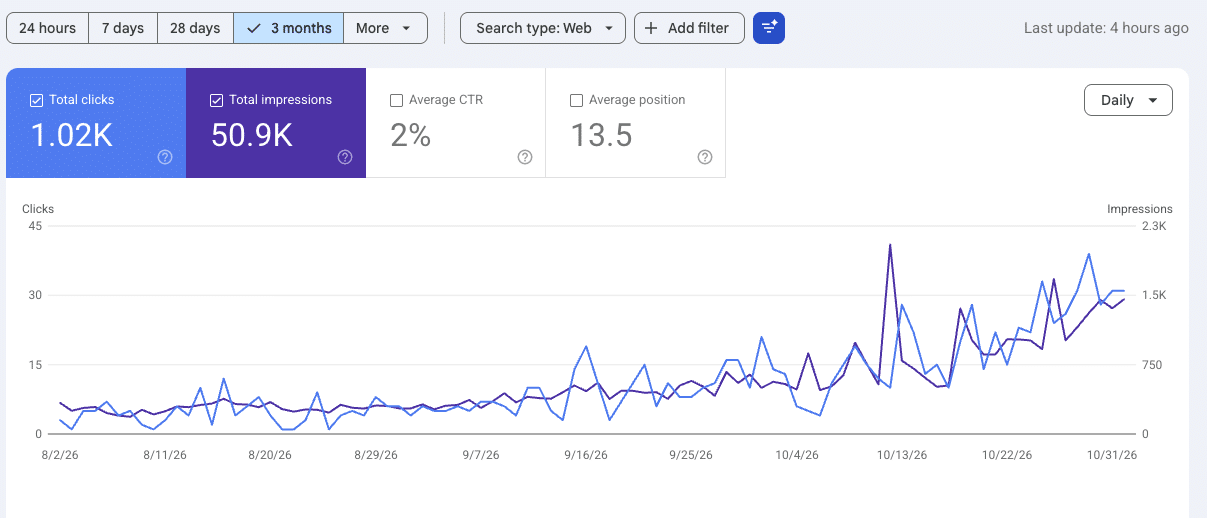
Obviously with a very slow/flat start, averaging about 11 users per day. With a good trend starting about a month and half in. Decent click through rate (anything between 3% and 6% would be considered “good”) and not showing up on the first page for the first three months as “average position” is higher than that top 10 mark you would aim for.
Let’s look at the most recent performance, now that we’ve got some momentum and we can cut out all of the runway that skews the data.
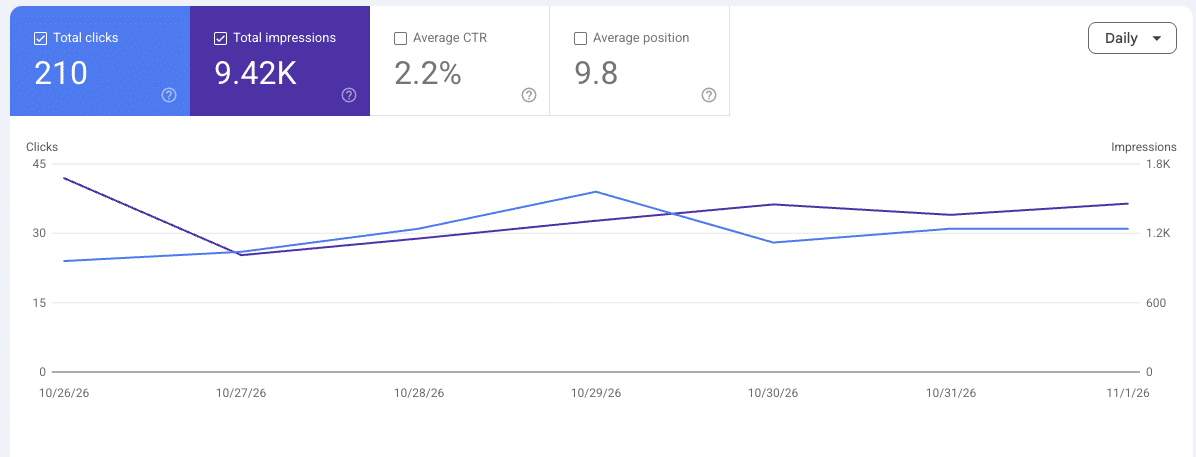
In just the last 7 days, the last 7 days of our 3 month test, we’re hitting the upper range of what’s “typical” with a site that’s doing everything right. Getting exactly 30 clicks per day, pushing into the first page for search (it is pretty niche, but still), and a mildly better click through rate.
The Caveat
Here’s the thing though. Google analytics is only grabbing traffic from users who have consented to us gathering and using their data. We’ve seen a firestorm of litigations coming out of mainly California on user privacy law, so we decided for our test/demo we’d play it extra safe. So Google can only get the data from people who consent. Is there a way to see the TRUE numbers for this site? Well yes, if you have the right tech stack.
We use Pressable.com to host this test site, 2aMarketplace.com, and using their server data, we can actually see how many unique devices/users loaded the page. We can see this, because we’re not collecting any data from the users, we’re simply listening to how many times the server has to load a page. It can even distinguish between bot traffic and human traffic, and this tells a totally different story:
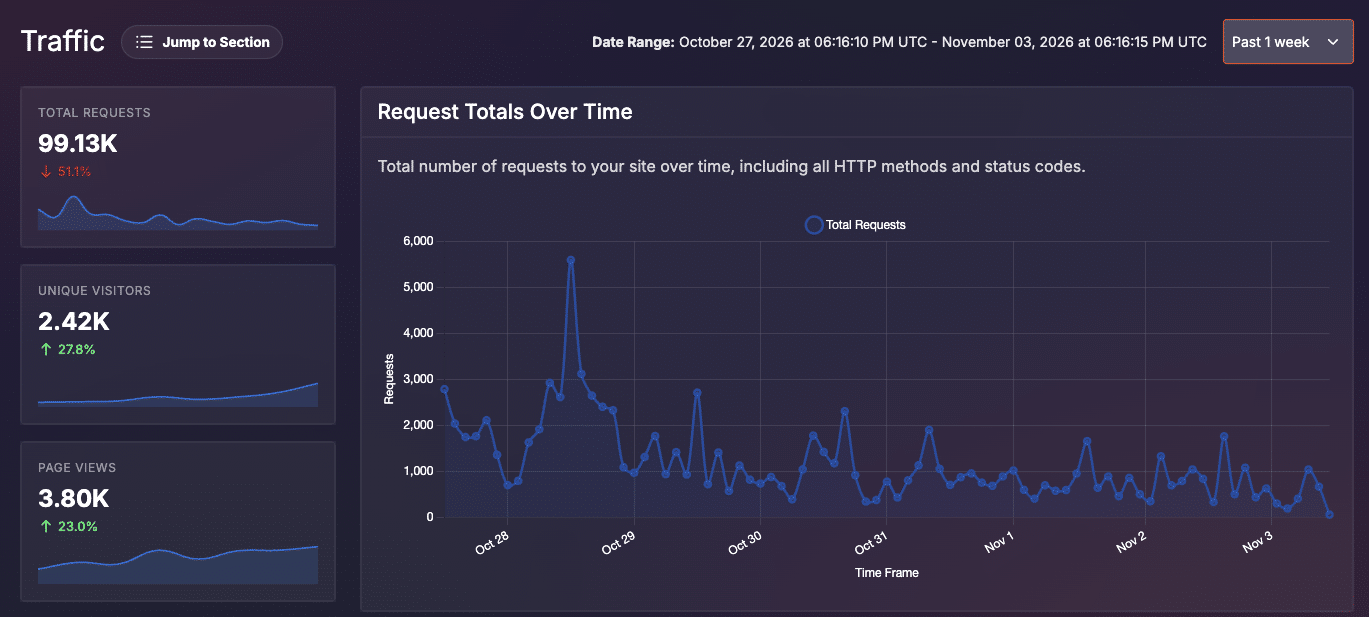
About 2,420 unique visitors overs the same 7-day period. Not pictured here is the report that shows that 88% of that is human traffic and 12% is bot traffic.
What Do We Learn?
You definitely CAN use large language models or AI to help with the heavy lifting in your SEO strategy, but don’t let it go wild and give it everything it needs to be successful. This is obviously a small sample size and it’s only barely performing according to what Google considers to be “good” or “average” for brand new sites. Things will change, and that’s okay, but we’re learning how to use these new AI tools together and everything we can learn to make our lives easier or better is a good thing. And if can provide real, helpful content, to our audiences and users at the same time, then it’s a win-win.
So stop generating ai slop. Put some effort in. Define your process. Create your format. Do the extra SEO work and, for now, it seems to be an acceptable tactic.